











Why your boiler won't turn on in a Connecticut winter

Send it once and finding someone is no longer on you.

Let a pro reach out

A boiler that won't fire in a Connecticut winter is usually stuck on one of a few things: no power getting to the control board, a thermostat that isn't calling for heat, a pilot or igniter that failed, or the system locked out on a pressure or safety switch. Cold snaps make this worse. When your house is losing heat fast because it's single digits outside, a boiler already running on a weak igniter or a flooded condensate line is more likely to trip out and stay off right when you need it most. Some of these are quick resets. A lockout switch or a low water pressure shutdown can sometimes be cleared by hand. Others, like a cracked heat exchanger or a failed control board, need a licensed technician to open the unit and test it. Either way, a boiler that won't start in January isn't something to leave overnight.

A gray-haired man in a dark long-sleeve shirt sits on a gray sofa in a living room, looking toward a sunlit window with sheer curtains.
A gray-haired man in a dark green sweatshirt sits on a sofa in a living room, looking toward a bright window, with a houseplant, lamp, fireplace and framed art behind him.
A gray-haired bearded man in a dark green collared sweater sits on a sofa in a living room with a window, houseplant, floor lamp and bookshelves, looking off to the side.
A gray-haired man in a dark green sweater sits on a sofa in a sunlit living room, looking off to the side, with a framed landscape painting, dining table and shelving behind him.

Call For Help, Or Check First

Call now

  • A boiler that won't fire in January isn't a wait and see problem, since a cold house can mean frozen pipes within a day or two.
  • A locked out boiler usually trips a safety switch for a reason, and running it again without finding that reason can mean a bigger failure later.
  • A gas smell near the unit, soot around the burner, or a tripped carbon monoxide alarm means the system needs to stay off until someone qualified looks at it.
  • If the control board or igniter has failed, parts for an older boiler sometimes have to be sourced, and that takes longer the later you start.
  • A no heat call in the middle of a cold snap gets treated differently than a routine service call, so saying what's happening now matters.

Try this first

  • Check that the thermostat is set to heat and a few degrees above room temperature, and that it has power if it runs on batteries.
  • Look at the boiler's low water cutoff and pressure gauge, since a reading near zero often means the system needs water added before it will fire.
  • Check the switch on the boiler and any emergency switch at the top of the basement stairs, since either one being off will stop it cold.
  • If there's a reset button on the front of the unit, press it once, since repeated resets without a fix usually make the problem worse.
  • Check that the furnace or boiler switch wasn't shut off by someone working on something else nearby, which happens more often than it sounds.
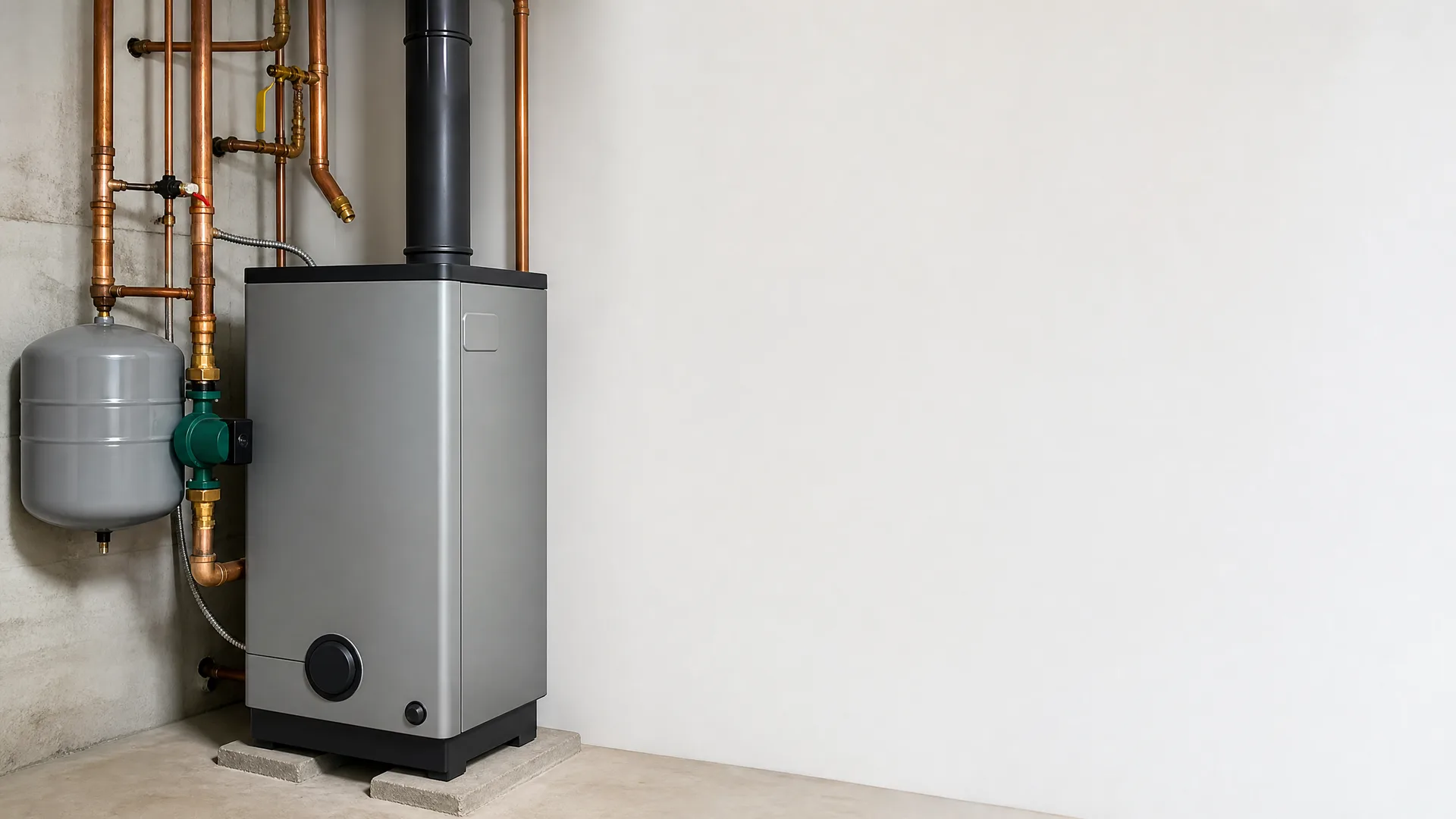
A gray floor-standing boiler with a black flue pipe stands on concrete blocks in a corner, connected to copper pipes, a green circulation pump, and a gray expansion tank on the wall.

Low water pressure trips the switch

Most boilers need to see between 12 and 15 psi on the gauge to run. If the needle has dropped below that, a pressure switch cuts power to the burner on purpose, before anything gets damaged. This happens after a slow leak, a bleed valve left open, or just normal loss over a season. A contractor can refill the loop and check whether the pressure holds, or keeps dropping.

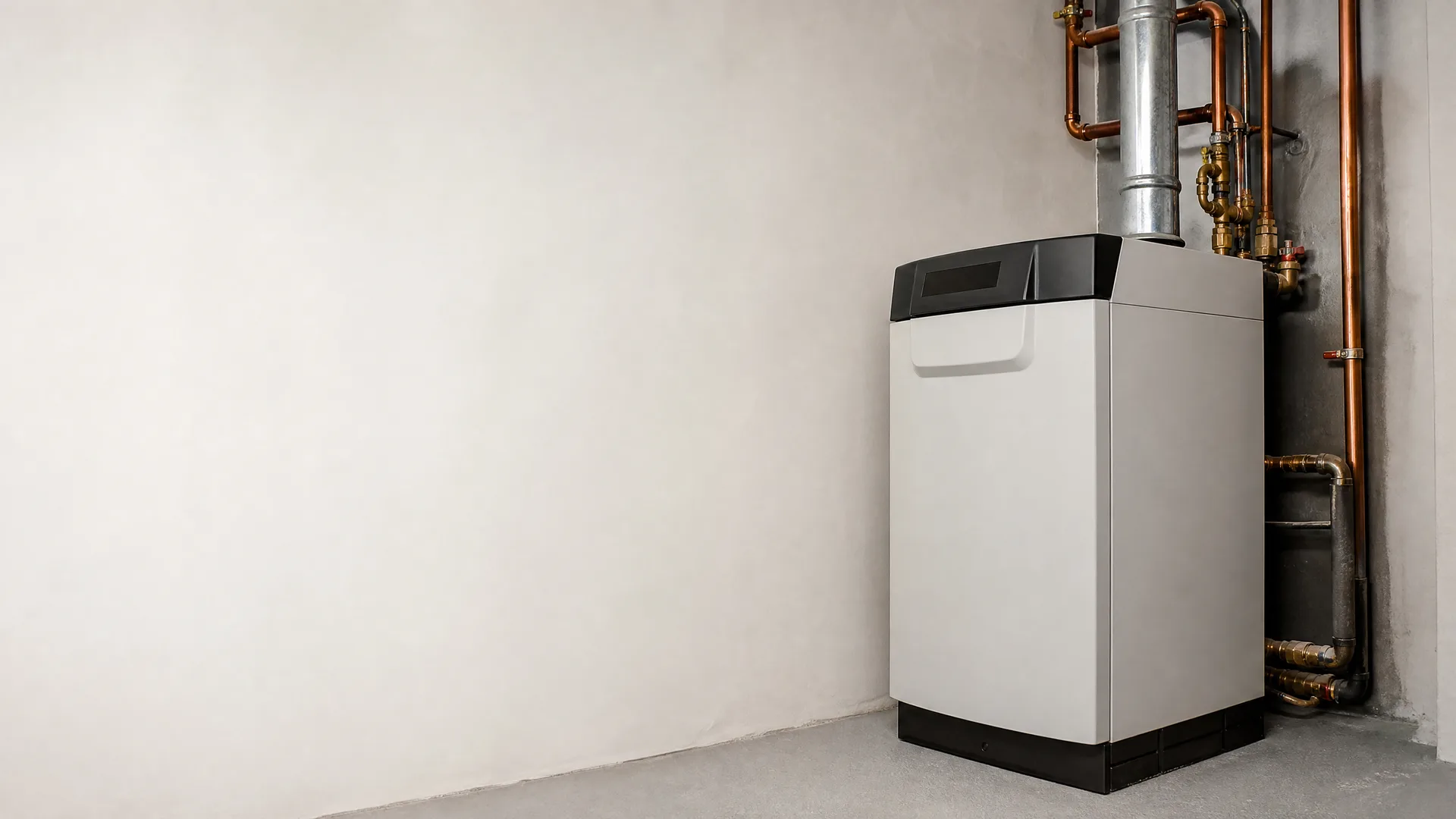
A white and black floor-standing boiler in the corner of a bare plastered room, with copper and metal pipes running up the wall behind it.

Condensate lines freeze in the cold

High efficiency boilers vent exhaust through a plastic pipe that runs outside, and that pipe carries condensate with it. When outdoor temperatures stay below freezing for a stretch, water sitting in that line can freeze solid and block the vent. The boiler's safety controls sense the blockage and shut the unit down rather than let exhaust back up into the house. Clearing the line usually gets the system running again.

Why is the house so cold this morning

You walk downstairs and the air feels the same temperature as outside. The radiators or baseboards are cold to the touch, even the ones nearest the boiler. The thermostat might show a number climbing nowhere, or a blank screen if it runs on batteries that died overnight. Near the boiler itself, you may hear nothing at all, no hum, no click, no burner catching, where there's usually at least some sound when it starts a cycle. Sometimes there's a faint oil smell or a burnt one if it tried and failed to light. In a Connecticut January, a house that can't hold heat starts losing water in the pipes to freezing within a day or two, which turns a boiler problem into a plumbing one.

A middle-aged woman with shoulder-length dark hair, wearing a gray cardigan over a cream top, sits in an upholstered armchair and looks toward a sunlit window, with a shelf holding framed pictures and a plant behind her.
A woman and a child wrapped together in a knitted gray blanket on a couch, with the child's head resting on her shoulder and a lit table lamp and houseplant in the background.
  1. Thermostat calls for heat and sends power to the control board.

  2. Control board opens the gas valve and starts the ignition sequence.

  3. Igniter or pilot lights the burner inside the sealed chamber.

  4. Flame sensor confirms a steady flame within seconds or shuts gas off.

A blue oil-fired boiler with a burner unit and pressure gauge stands in a concrete basement corner, connected to copper pipes and a metal flue.
Before you get your boiler repair
A gray floor-standing boiler with a metal flue stands against a concrete block wall, connected to copper pipes, brass valves and a gray expansion tank, on a bare concrete floor.
After you get your boiler repair

Hand off the boiler problem

The pro who reaches out is licensed in Connecticut.

No charge to send it. You decide if you hire them.

Try resetting it yourself

Some boiler shutdowns are simple. If the breaker tripped or the switch on the side got bumped, flipping it back and giving the system a few minutes can bring it back. You might save a call. But a boiler that locked out on a safety switch, lost its flame signal, or has a cracked heat exchanger won't stay fixed from a reset. It'll run for a bit, maybe a day, and shut down again. Each restart with no diagnosis is a guess, and in a Connecticut January a wrong guess costs you the one thing you don't have, which is time.


Get a licensed tech out

A tech who services boilers all winter in Connecticut has seen this fail in these houses before and knows where to look first. They'll check pressure, igniter, flame sensor, and the safety switches in order, and find the actual reason it shut down instead of just clearing the lockout. One contractor comes, not three calling at once. It costs you a call instead of a guess, and once that call is made, finding the right person stops being something you have to manage yourself.

Winter nights average 23°F statewide

23°F is the average overnight low across a Connecticut winter, not the worst of it. A boiler sitting unused or struggling to keep up on a night like that loses the house fast, and pipes along outside walls are the first to feel it.

NOAA nClimDiv 1991-2020 county normals weighted by homes

Where this leaves you

  • A boiler that won't fire almost always traces back to power, the thermostat, the ignition, or a safety switch doing its job.
  • Finding which one it is takes someone who opens the panel and checks the sequence step by step, not a guess over the phone.
  • A contractor working on boilers all winter in Connecticut has likely seen your model lock out for this exact reason before.
  • Once you send the request, one licensed local contractor takes it from there, so you're not fielding calls from several companies at once.
  • A cold house in January doesn't give you much room to wait on a callback that doesn't come.

A boiler that won't turn on comes down to one of four things. Power isn't reaching the control board, the thermostat isn't sending a call for heat, the pilot or igniter failed to light the burner, or a safety switch tripped and locked the system out on purpose. Which one it is isn't something you can tell from the thermostat or the panel lights alone. It takes someone standing in front of the boiler, opening it up, and checking the sequence from the thermostat call through to the flame.

That's where a local contractor earns the call. Someone who services boilers through a Connecticut winter sees the same handful of failures over and over, often on the same models, and knows which one tends to show up after a cold snap or a slow pressure leak. That kind of familiarity shortens the diagnosis. Instead of ruling things out one at a time, they can often go straight to what's most likely failed on a system like yours.

Send the request and it goes to one licensed contractor local to you, not a handful of companies competing for the job. You deal with one name, one visit, and someone who already knows the kind of boiler trouble this weather causes. With the house cold and pipes at risk, that's one less thing to manage while you wait for the heat to come back on.

A single-story stucco house at dusk with a lit paver walkway lined by low path lights, desert plants and boulders in front, and distant mountains under an orange and blue sky.

Boiler Repair

Send one request and you're done looking

Step 1 of 3: Equipment
  • A beige upholstered armchair with an olive cushion sits in a sunlit corner beside a wooden side table holding a ceramic vase with leafy branches, under a framed abstract artwork, on a woven rug over a wood floor.
    • Tell a local repair pro what your boiler is doing.
    • Describe your boiler job, and a local pro who handles it gets in touch.
  • A gray outdoor condenser unit on a concrete pad surrounded by dark gravel, beside a dark wood-sided wall with an electrical disconnect box and a stone veneer wall with a small evergreen shrub.
    • Once you send the form, finding a pro is off your list.
    • After you send the request, you're done searching.
  • A beige upholstered oversized armchair with a matching cushion and a knit throw draped over one arm, beside a round wooden side table holding a vase of greenery near a curtained window, with a framed landscape print on the wall and a woven rug on a wood floor.
    • Describe what your boiler is doing once, in one form.
    • Answer a few questions instead of calling shop after shop.
  • Sunlit living room corner with a beige upholstered sofa, cushion and knitted throw, a round wooden side table holding a white ceramic vase of leafy branches and a small wooden bowl, a framed landscape painting on the wall, and a window at right.
    • Your request stays with one local pro.
    • Your request goes to one pro, not a list of companies.


