Tell us about the job
Takes about a minute. No obligation.
Sizing a boiler correctly in South Central Connecticut matters more than it would somewhere the heat runs briefly. Homes in South Central Connecticut Planning Region, CT run heat about eight months a year, from October through May. The burner and ignition system cycle every time the house calls for heat, and that adds up across a long, consistent season. A boiler that is undersized for the load runs longer and more frequently to keep up, and the ignition and heat exchanger wear faster for it. A contractor quoting a replacement has to establish the actual heat load of the house before specifying equipment, because a unit that passes a loose inspection in a short winter will show the mismatch here.
Ductwork laid down for equipment that no longer exists is what a contractor has to account for first in much of this region. Half the homes in South Central Connecticut Planning Region, Connecticut were built in 1964 or earlier (2020-2024 ACS 5-year). That history means the pipe runs, junction points, and distribution layout a house already holds were sized and routed for something different from what a contractor is being asked to install now. A boiler going into a house like that puts the structural question before the equipment question: whether what is already in place will carry the new system without being rebuilt around it.
What Gets Installed With a New Boiler
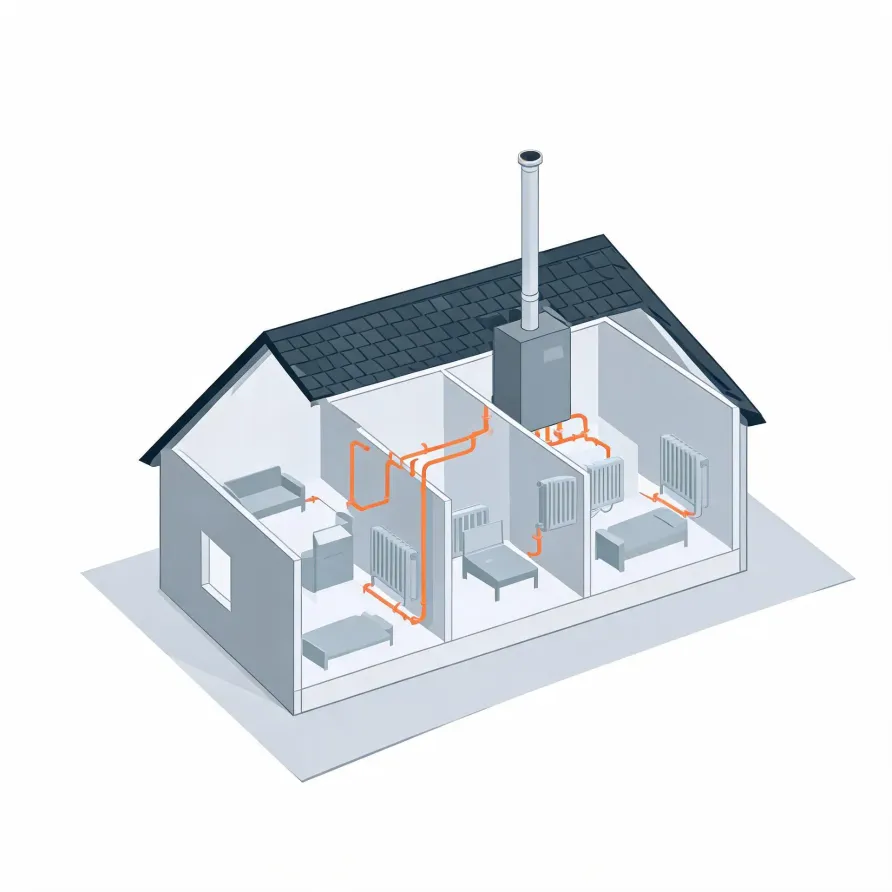
The boiler itself sits in a utility space, typically the basement or a mechanical room, and is the unit that heats water and sends it through the system. Alongside it, the expansion tank manages pressure as water heats and cools. These are the pieces a homeowner is buying when they sign off on a new installation.
From the boiler, supply and return pipes run through the house to radiators or radiant floor loops in the living spaces. A circulator pump drives the water through those pipes, and a zone valve or thermostat controls when each area calls for heat.
The drawing shows a general layout of these components, and a licensed contractor determines exactly what applies to your house and how each piece gets configured.
Find a contractor in South Central Connecticut Planning RegionSouth Central Connecticut Planning Region, by the numbers
Half the homes in South Central Connecticut Planning Region, Connecticut were built in 1964 or earlier (2020-2024 ACS 5-year).
U.S. Census Bureau, 2020-2024 American Community Survey 5-Year EstimatesSouth Central Connecticut Planning Region, Connecticut holds 248,267 housing units (2020-2024 ACS 5-year).
U.S. Census Bureau, 2020-2024 American Community Survey 5-Year EstimatesOwners occupy 60.5% of the occupied homes in South Central Connecticut Planning Region, Connecticut (2020-2024 ACS 5-year).
U.S. Census Bureau, 2020-2024 American Community Survey 5-Year EstimatesBoiler Installation Rules for South Central Connecticut Planning Region, Connecticut1 codes, standards, and licensing rules
Licensing and Legal Requirements in South Central Connecticut Planning Region, Connecticut
Connecticut requires a state licence to perform, or to advertise, heating, piping and cooling work: no person may practise an occupation this chapter covers without first obtaining one.