Tell us about the job
Takes about a minute. No obligation.
Sizing a boiler for this area starts with understanding what the burner and heat exchanger are genuinely asked to carry. Homes in Lower Connecticut River Valley Planning Region, CT run heat about eight months a year, from October through May. A boiler that is undersized for the house or installed without a proper load calculation cycles harder and more often than one sized to match the actual demand, and the heat exchanger and ignition system take that punishment directly. A contractor quoting a replacement here has to establish the correct output for the structure before anything else, because an installation that is off by even a modest margin shows its faults well before the equipment would otherwise reach the end of its service life.
Ductwork laid out for one kind of heating system does not automatically suit another, and much of the housing here was configured around equipment that has since been replaced at least once. Half the homes in Lower Connecticut River Valley Planning Region, Connecticut were built in 1972 or earlier (2020-2024 ACS 5-year). When a licensed contractor quotes a boiler installation in a house from that era, the ductwork layout and its condition shape the scope more than the new unit does. A boiler that fits the space on paper still has to move heat through what is already in the walls.
What Goes Into a New Boiler Installation
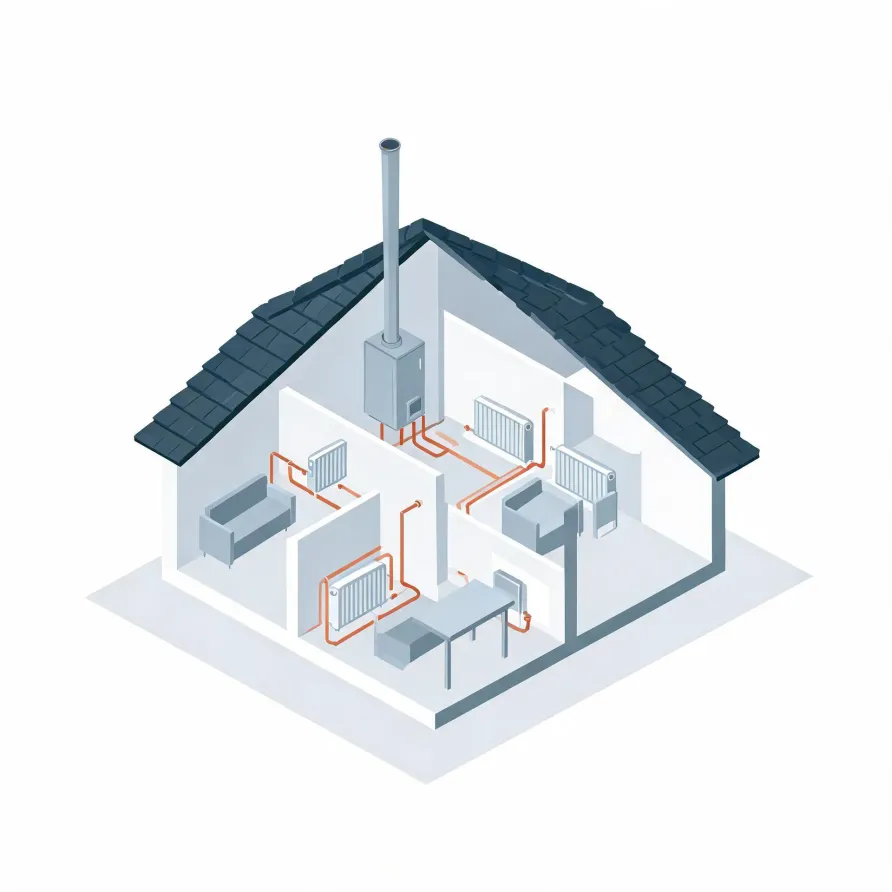
The boiler itself sits in the basement or utility room and is the heart of the system, burning fuel to heat water that circulates through the house. Alongside it, the expansion tank absorbs pressure shifts in the water as it heats and cools, and the circulator pump moves that heated water out through the pipes.
The thermostat on a main living-area wall tells the boiler when to fire and when to rest. At the end of the distribution loop, baseboard units or radiators in each room release the heat into the living space, and a pressure relief valve mounted at the boiler itself acts as the system's safety device.
The drawing shows the typical layout of these components, and a licensed contractor determines exactly what applies to your house.
Find a contractor in Lower Connecticut River Valley Planning RegionLower Connecticut River Valley by the Numbers
Half the homes in Lower Connecticut River Valley Planning Region, Connecticut were built in 1972 or earlier (2020-2024 ACS 5-year).
U.S. Census Bureau, 2020-2024 American Community Survey 5-Year EstimatesLower Connecticut River Valley Planning Region, Connecticut holds 82,963 housing units (2020-2024 ACS 5-year).
U.S. Census Bureau, 2020-2024 American Community Survey 5-Year EstimatesOwners occupy 75.8% of the occupied homes in Lower Connecticut River Valley Planning Region, Connecticut (2020-2024 ACS 5-year).
U.S. Census Bureau, 2020-2024 American Community Survey 5-Year EstimatesBoiler Installation Rules for Lower Connecticut River Valley Planning Region, Connecticut1 codes, standards, and licensing rules
Licensing and Legal Requirements in Lower Connecticut River Valley Planning Region, Connecticut
Connecticut requires a state licence to perform, or to advertise, heating, piping and cooling work: no person may practise an occupation this chapter covers without first obtaining one.