Tell us about the job
Takes about a minute. No obligation.
On a boiler repair, a contractor's first question is which components have been doing the most work. Homes in Lower Connecticut River Valley Planning Region, CT run heat about eight months a year, from October through May. Burners and ignition assemblies cycle every time the system calls for heat, and a season that long means those parts have fired and cooled hundreds of times before a fault surfaces. Heat exchanger fatigue follows the same pattern. A contractor here checks combustion integrity and ignition reliability before moving to secondary components, because that is where the accumulated load lands first.
Boiler systems in housing this old accumulate a specific kind of deferred wear: zone valves that have been cycled through decades of heating seasons, heat exchangers carrying sediment that no annual tune-up fully cleared, and expansion tanks that were never swapped when the original boiler was. Half the homes in Lower Connecticut River Valley Planning Region, Connecticut were built in 1972 or earlier (2020-2024 ACS 5-year). A contractor opening the system on a repair call here is not pricing one failed part. What they find often reframes the job, because the plumbing that feeds a boiler in stock this age has been added to and patched over time, and the weak points are distributed through it.
The Parts of a Boiler a Contractor Checks First
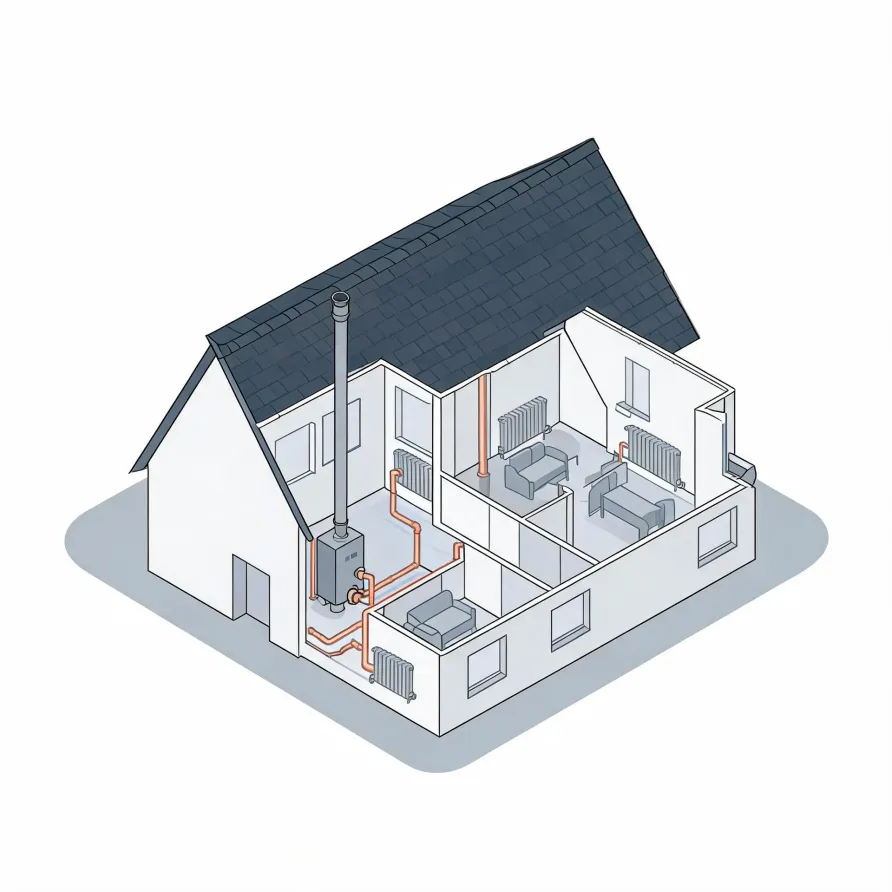
The boiler itself sits in the basement or a utility room and is the piece a contractor goes to first. It heats water and pushes it through the system. When heat is absent or uneven, the burner assembly, heat exchanger, or circulator pump inside the unit are the usual places a contractor starts.
Radiators or baseboard convectors sit in each room and release heat from the water passing through them. The expansion tank, pressure relief valve, and thermostat all tie into the loop as well, each one a point where a fault can stop the system or make it behave oddly.
The drawing shows a general layout of how these parts relate, and a licensed contractor determines what applies to the specific system in your house.
Find a contractor in Lower Connecticut River Valley Planning RegionLower Connecticut River Valley Planning Region, by the numbers
Half the homes in Lower Connecticut River Valley Planning Region, Connecticut were built in 1972 or earlier (2020-2024 ACS 5-year).
U.S. Census Bureau, 2020-2024 American Community Survey 5-Year EstimatesLower Connecticut River Valley Planning Region, Connecticut holds 82,963 housing units (2020-2024 ACS 5-year).
U.S. Census Bureau, 2020-2024 American Community Survey 5-Year EstimatesOwners occupy 75.8% of the occupied homes in Lower Connecticut River Valley Planning Region, Connecticut (2020-2024 ACS 5-year).
U.S. Census Bureau, 2020-2024 American Community Survey 5-Year EstimatesBoiler Repair Rules & Codes for Lower Connecticut River Valley Planning Region, Connecticut1 sourced standards and statutes
Licensing Rules for HVAC Repair in Lower Connecticut River Valley Planning Region, Connecticut
Connecticut requires a state licence to perform, or to advertise, heating, piping and cooling work: no person may practise an occupation this chapter covers without first obtaining one.