Tell us about the job
Takes about a minute. No obligation.
A boiler repair in Southeastern Connecticut starts with what the equipment has already been asked to carry. Homes in Southeastern Connecticut Planning Region, CT run heat about eight months a year, from October through May. Burner cycles and heat exchanger stress add up across that kind of season, and the ignition system and heat exchanger are where a contractor looks first. Corrosion, fatigue cracks, and worn igniter contacts show up in those parts before anything else on the unit gives way.
Boilers do not stand alone. The pipes, zone valves, and controls around them were designed for whatever system came first, and in a county where the housing stock runs this old, that original configuration shapes what a repair actually requires. Half the homes in Southeastern Connecticut Planning Region, Connecticut were built in 1969 or earlier (2020-2024 ACS 5-year). A contractor opening a boiler in a house like this often finds that the unit itself is the simpler part of the call. What takes time is tracing how the distribution system was modified over the years and whether those modifications are compatible with what the boiler now needs to do.
The Parts of a Boiler a Contractor Checks First
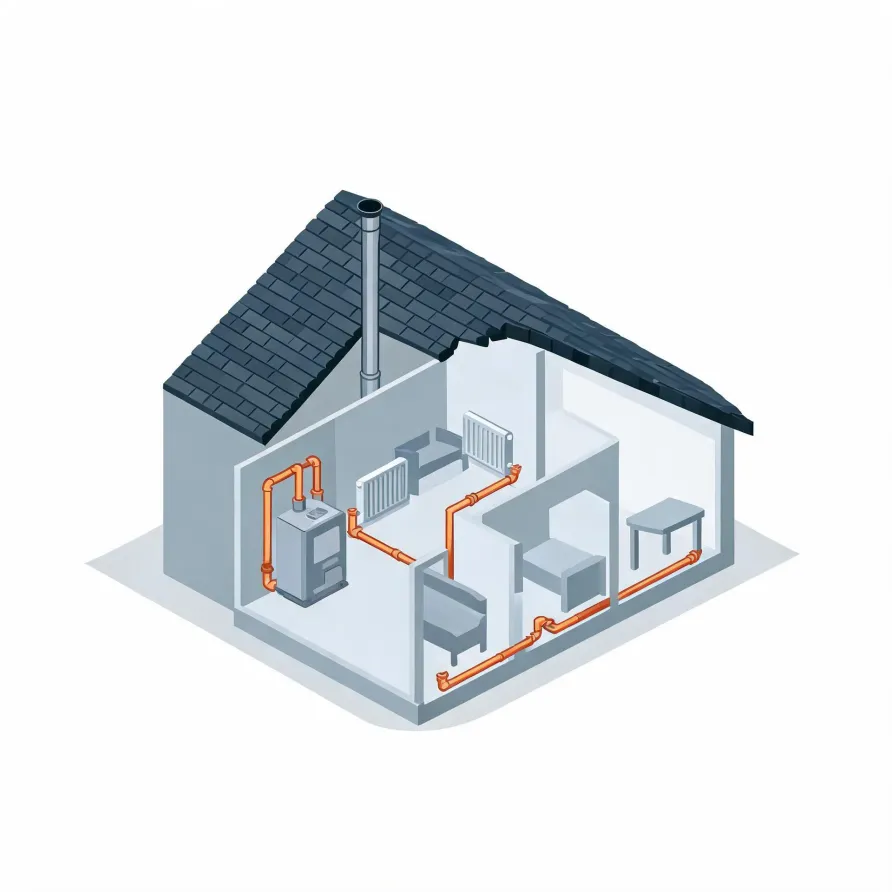
The boiler itself sits in the basement or a utility room and is the piece a contractor goes to first. It houses the burner, the heat exchanger, and the controls that regulate combustion. When heating fails or the system short-cycles, the problem usually starts here.
From the boiler, supply pipes carry hot water to radiators or baseboard units throughout the house, and return pipes bring cooled water back. The circulator pump moves water through that loop. The expansion tank, pressure relief valve, and aquastat all sit near the boiler and each one is a point a contractor checks when something is off.
The drawing shows a typical boiler layout, and a licensed contractor determines which components and conditions apply to this specific house.
Find a contractor in Southeastern Connecticut Planning RegionSoutheastern Connecticut by the Numbers
Half the homes in Southeastern Connecticut Planning Region, Connecticut were built in 1969 or earlier (2020-2024 ACS 5-year).
U.S. Census Bureau, 2020-2024 American Community Survey 5-Year EstimatesSoutheastern Connecticut Planning Region, Connecticut holds 126,425 housing units (2020-2024 ACS 5-year).
U.S. Census Bureau, 2020-2024 American Community Survey 5-Year EstimatesOwners occupy 65.1% of the occupied homes in Southeastern Connecticut Planning Region, Connecticut (2020-2024 ACS 5-year).
U.S. Census Bureau, 2020-2024 American Community Survey 5-Year EstimatesBoiler & HVAC Repair Rules on the Books for Southeastern Connecticut Planning Region, Connecticut1 codes, standards & licensing rules
Licensing and Legal Requirements in Southeastern Connecticut Planning Region, Connecticut
Connecticut requires a state licence to perform, or to advertise, heating, piping and cooling work: no person may practise an occupation this chapter covers without first obtaining one.