Tell us about the job
Takes about a minute. No obligation.
A contractor quoting a boiler replacement in this area has to establish what the existing system has actually been asked to carry before they can size the new one correctly. Homes in Southeastern Connecticut Planning Region, CT run heat about eight months a year, from October through May. Burner ignitions, heat exchanger cycles, and expansion stress on cast iron or steel sections all accumulate across those months and leave physical evidence: hairline cracks, scale buildup, and ignition components that are closer to the end of their service life than their age alone suggests. A contractor who skips a proper load calculation and installs to rule of thumb risks putting an undersized boiler into a house where the heating demand has already exposed every weakness in the previous one.
Pipe runs, clearances, and heat distribution layouts in a house here reflect the system the building was designed around, and what a contractor finds when they open walls or crawl a basement is a configuration built for something that has long since been replaced. Half the homes in Southeastern Connecticut Planning Region, Connecticut were built in 1969 or earlier (2020-2024 ACS 5-year). That history shapes a boiler installation directly: the existing distribution piping may have been adapted more than once, and a contractor has to trace what is actually there before any sizing or placement decision holds. What the house already contains is the variable that drives the job.
What Gets Installed With a New Boiler
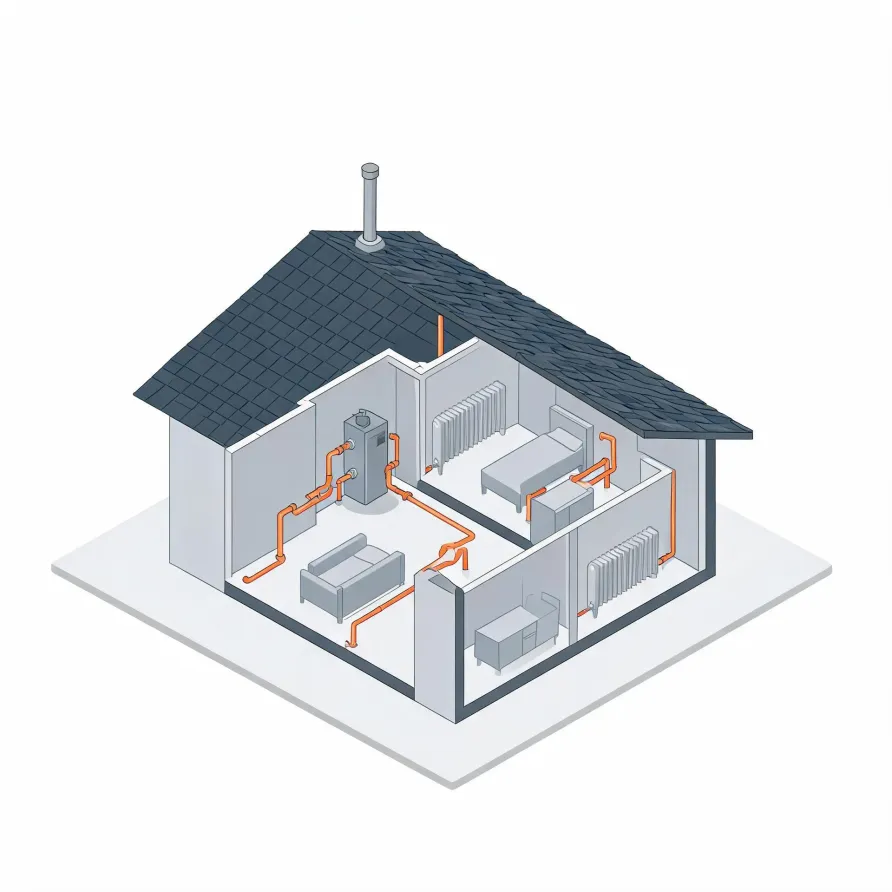
The boiler itself sits in the basement or a mechanical room and burns fuel to heat water. A contractor mounts it against a wall or on the floor, connects it to the gas or oil supply, and ties it into the home's plumbing. That unit is the core of everything else on the drawing.
From the boiler, supply pipes run through the house to radiators, baseboard units, or radiant loops in the floor, each of which delivers heat to a room. A circulator pump, mounted close to the boiler, moves the hot water through those pipes. The expansion tank and pressure relief valve sit nearby, keeping the closed loop at a safe, steady pressure.
The drawing shows a typical boiler layout, and a licensed contractor determines what the specific setup in your house calls for.
Find a contractor in Southeastern Connecticut Planning RegionSoutheastern Connecticut Planning Region by the numbers
Half the homes in Southeastern Connecticut Planning Region, Connecticut were built in 1969 or earlier (2020-2024 ACS 5-year).
U.S. Census Bureau, 2020-2024 American Community Survey 5-Year EstimatesSoutheastern Connecticut Planning Region, Connecticut holds 126,425 housing units (2020-2024 ACS 5-year).
U.S. Census Bureau, 2020-2024 American Community Survey 5-Year EstimatesOwners occupy 65.1% of the occupied homes in Southeastern Connecticut Planning Region, Connecticut (2020-2024 ACS 5-year).
U.S. Census Bureau, 2020-2024 American Community Survey 5-Year EstimatesBoiler Installation Rules for Southeastern Connecticut Planning Region, Connecticut1 codes, standards, and licensing rules
Licensing and Legal Requirements in Southeastern Connecticut Planning Region, Connecticut
Connecticut requires a state licence to perform, or to advertise, heating, piping and cooling work: no person may practise an occupation this chapter covers without first obtaining one.